About
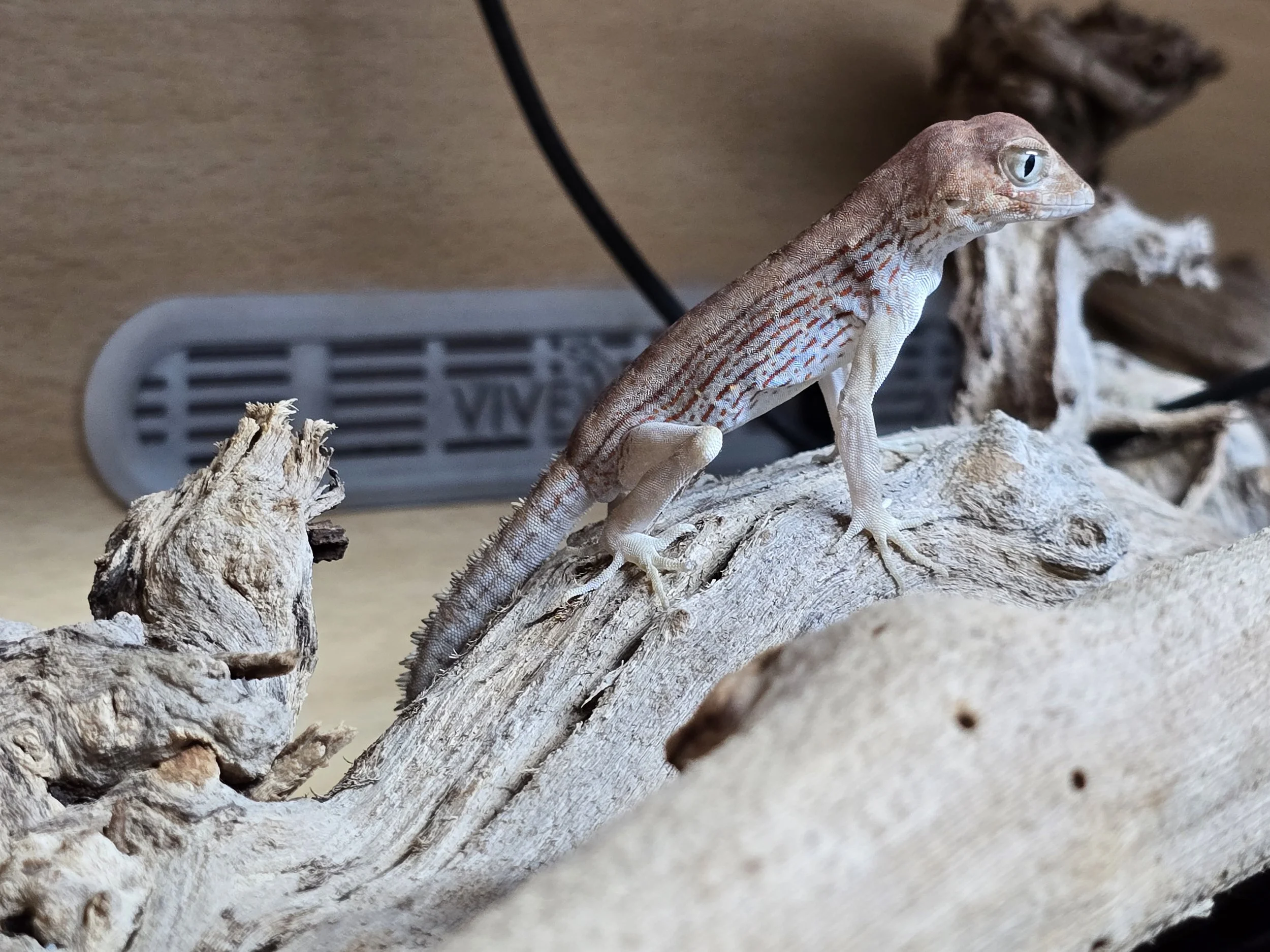
Pristurus Carteri, aka Scorpion Tail Geckos, are a desert dwelling gecko with several locales. We deal with Masirah, Salalah and ‘Reds’ or ‘Pinks’‘. Carteri were my personal introduction to the Pristurus genus and their behaviours and appearance interested me enough to become obsessed enough to find other species within the genus.
Carteri activity can best be described as cathemeral. Whilst I would predominantly describe them as day present nocturnal, they can also be quite active during the day. By day present I mean they are on display in some capacity. Not hiding, sleeping under substrate or in crevices or caves. Instead they bask and thermoregulate between snoozes.
Carteri are typically considered terrestrial for this genus though they do spend a lot of time climbing. During the day they will spend their time basking and thermoregulating, and often just sleeping under the basking lamp. Despite having no eyelids you can tell they’re sleeping by their eyes, with the pupils becoming like slits rather than spherical.
Appearance wise Carteri are the largest of the Pristurus genus with a snout to vent length of 4-7cm and an overall length of up to 10cm including tail. For this genus in partcular I’d consider them particularly bulky in appearance. Their tone is traditionally matched to their rocky habitat of origin but typically grey and brown being the dominant colours with white or yellow tummy and red markings on their flank.
Carteri live for around five to ten years and reach sexual maturity around nine months old, but breeding is not recommended for a further six months for females - in total about 15 months. Males can breed once maturity is reached. I’ll delve more into this in the sexing section below.
Carteri are often referred to as semaphore rock geckos along with several other species of Pristurus. Semaphoring is a fancy term to describe animals that wave limbs or tails to communicate to each other. If you have more than one in an enclosure, you’ll see these behaviours constantly throughout the day and it’s absolutely fascinating to watch!
The scorpion tail name comes from the male’s mating display. The tail curls up towards the back and waves side to side, up and down and typically starts high before moving lower and lower until stopping. Males also sometimes inflate their bodies and necks, along with short lunging behaviour to make themselves look larger. You’ll notice these behaviours particularly when you enter the enclosure to either change water bowls or add food. The males will back away whilst inflating, then once your hand leaves the enclosure they will tail wave. Like “yeah, you better leave”.
That said, they’re absolute sweethearts. I currently have around forty Carteri. Had several hundred. Not once have they bitten, charged or acted in an aggressive manner towards me, my children or other people. But they can fight amongst themselves. I’ve had my largest male, an absolute unit but the sweetest dude ever called Scoobs, had a chunk bitten out of his tail by an adolescent male called Cameron I’d tried to introduce into their group. Honestly since this I have always kept only one male in any enclosure.
Housing
Housing should focus on length rather than height. These are a desert species so think about good ventilation and capable of handling high temperatures.
Enclosure Size
Single male or female, or male and female pair – 57.5x37.5x42cm
Male and multiple females - 86x37.5x42cm (minimum, larger is great)
Carteri can be social especially female groups or a male and multiple females. Batchelor groups have been done before but personally I just would not risk the injuries with multiple males.
Substrate –
A desert mix or sand base with top soil is suitable for adults. I recommend a desert mix 2/3 and 1/3 soil. Carteri dig, especially when laying eggs but I have found they also dig looking for insects. Aim for around 2-3 inches across the enclosure or if breeding, 2 inches across most of the enclosure with a spot around 4 inches deep to encourage laying in that spot.
For babies, they're so small, even a small amount of sand or debris may cause impaction. Leave them for around six to eight weeks without substrate before introducing.
Climbing Opportunities
Carteri spend just under half of their lives climbing. With the majority being on the ground. They climb to thermoregulate and particularly like a branch or rock under a basking light.
Rocks are great for climbing and basking. I have rocks under each basking lamp and see them basking multiple times per day. Not only do they provide a platform to bask and climb on but they offer places to hide and heat retention.
Branches provide perfect climbing opportunities both on top of and underneath each branch and can be used for shelter.
Backgrounds are not something I have tried with Carteri but I seen no reason why they would not use them.
Hides are important and not only do they provide a climbing opportunity but a place to hide. Some Carteri I have spend most of their time hiding away in small caves and come out at night and for short periods of time during the day for thermoregulation and UVB exposure.
Other Decorations
If you have the opportunity to provide any other climbing structures – great!
Lighting
UVB is essential for their health and wellbeing. Use a suitable high strength UVB light form and aim for a UVI around 5-6 – essentially Ferguson Zone 4. In the wild these guys are basking in desert sun but ensure there is ample opportunity to escape from the blaze. Ignore the Arcadia guide suggesting these are a low UVB species - they certainly are not!
Heating
Aim for a basking spot around 35-40c, 95-104f (in freedom units). With a background temperature of 30c. You can achieve this easily enough with a single 25-50w basking bulb depending on enclosure size and the excess heat will escape through the mesh.
For evening heat I use a either a heat mat under the terrarium set to 20c which not only helps with temperature but can also aid incubation for any hidden, fertile eggs. Or a ceramic heat emitter which will offer the same temperature regulation.
Throughout most of the year I have light and basking heat set for 06:00-18:00 on a digital timer. Then 18:00-06:00 for evening. Around November time I reduce ‘day’ to 10 hours then in December 8 hours. Increase again in January then back to normal again in February. I also drop the temperatures to accompany each hour change
November - 06:00-16:00 and background temperature 28c
December - 08:00-16:00 and background temperatures 25c
January - 06:00-16:00 and background temperature 28c
February to October - 06:00-18:00 and background temperatures 30c
Remember to regulate temperatures using a suitable thermostat. Reptiles love some heat but don’t tolerate being cooked.
Watering
Misting is the best way to water your Carteri. Simply get a small spray bottle and 5-8 sprays on them and around their enclosure is sufficient. They will lick the water from their mouths/eyes/head and drink from the enclosure sides. I’ve never seen them drink standing water but they do love to sit in water bowls. So I always provide them with standing water. Just be aware that this will more often than not be used as a toilet. They chill in this and crap themselves.
Get a spray bottle from a cheap hardware store, in the UK Poundstretchers sell them for 69p vs about £5 for a reptile branded one.
As an aside, every third watering I add about 20ml of Zolcal (liquid calcium supplement) to every 500ml bottle. Just for extra calcium. Really they’re only drinking a small amount of water anyway and this tiny addition is just extra help for their little bodies. This isn’t really a requirement but I’ve found it helps. If you have an egg laying female do this every time or every second spray.
Misting programme suggesting:
Up to 1 month old – twice daily
1 Month old + – Misting once daily, occasionally skipping a day to replicate natural cycles.
Feeding
A good rule of thumb for any lizard is no food source wider than the space between the eyes. This is considered the thickest meal they can swallow safely. Dusting a calcium supplement each feed is recommended and add a multi vit supplement powder every 3rd feed.
0-1 Month – Micro crickets, fruit flies, mini mealworms. Feed daily. Filter out your meal worms by grabbing a handful and sorting for the smallest ones possible
1-2 months – Small crickets, small calci worms, small meal worms. . Feed five to six days a week.
2 months plus – Much the same as the above, except larger meal worms can now be accommodated. Crickets and calci worms can be scaled up to appropriate sizes. Feed every second day throughout this age into adulthood. For example Monday, Wednesday, Friday, Sunday, Tuesday, etc
It should be noted that as adults, a sudden increase in feeding quantity and frequency can stimulate a breeding response. Feeding daily as adults will result in babies appearing almost fortnightly (if keep with at least one male and one female, obviously).
Males and Females
I do not recommend females as pets for inexperienced keepers
Sexual dimorphism is very obvious Carteri. Males are more than double the weight of females and although not double the size in terms of length, the bulk/mass of their bodies is significant.
Males - Much larger than females, presence of balls/bulges at base of tail where it connects to the body and also the tail has very obvious spiking along the length. If you’re familiar with a sawfish rostrum, this is what a male Carteri’s tail looks like. The males also inflate themselves when scared or feel threatened and do their self described scorpion-tail displays regularly during warmer months.
Females - Noticeably smaller than males, lack any form of bulging, the tails can either lack any form of spiking or minimal spiking and very rarely, if ever, do they tail display. It should be noted that even without pairing with a male, the females will produce waxy eggs upon entering puberty which they will discard on the surface of the substrate, branches, rocks, etc. As they mature they may still leave waxy eggs or fully visually (albeit not fertile) apparent ‘real’ eggs but again these will be discarded. A general rule of thumb is if the eggs are laid with care, ie buried and covered over, they’re likely to be fertile. Discarded eggs generally = infertile.
Just on the subject of egg laying, the mothers are amazing when it comes to fertile eggs. There is no maternal care following laying and in fact, cannibalism is common if the babies are not removed from the parent’s enclosure. But in terms of laying fertile eggs the mothers will dig a deep hole, hold their bodies off the ground with their front legs and catch the egg with their rear legs. They will then hold this until the egg shell firms up before burying and moving away from the area.
Controversially for a breeder, I haven’t yet sold a female and I honestly do not believe the females make great pets. Aside from being timid and hiding more, they don’t really display and generally just move about to thermoregulate and eat. However the main issue I have is the calcium monitoring. Females are incredibly timid and may stop eating if disturbed too much and in turn this leads to calcium deficiency. Their calcium intake needs to be closely monitored especially when producing eggs. It’s an incredibly fine line between providing enough calcium for their bodily functions and egg producing vs overdosing. And for that reason I honestly think the males are the only ones I’d ever consider selling unless the person buying could suitably demonstrate their care and close observation.