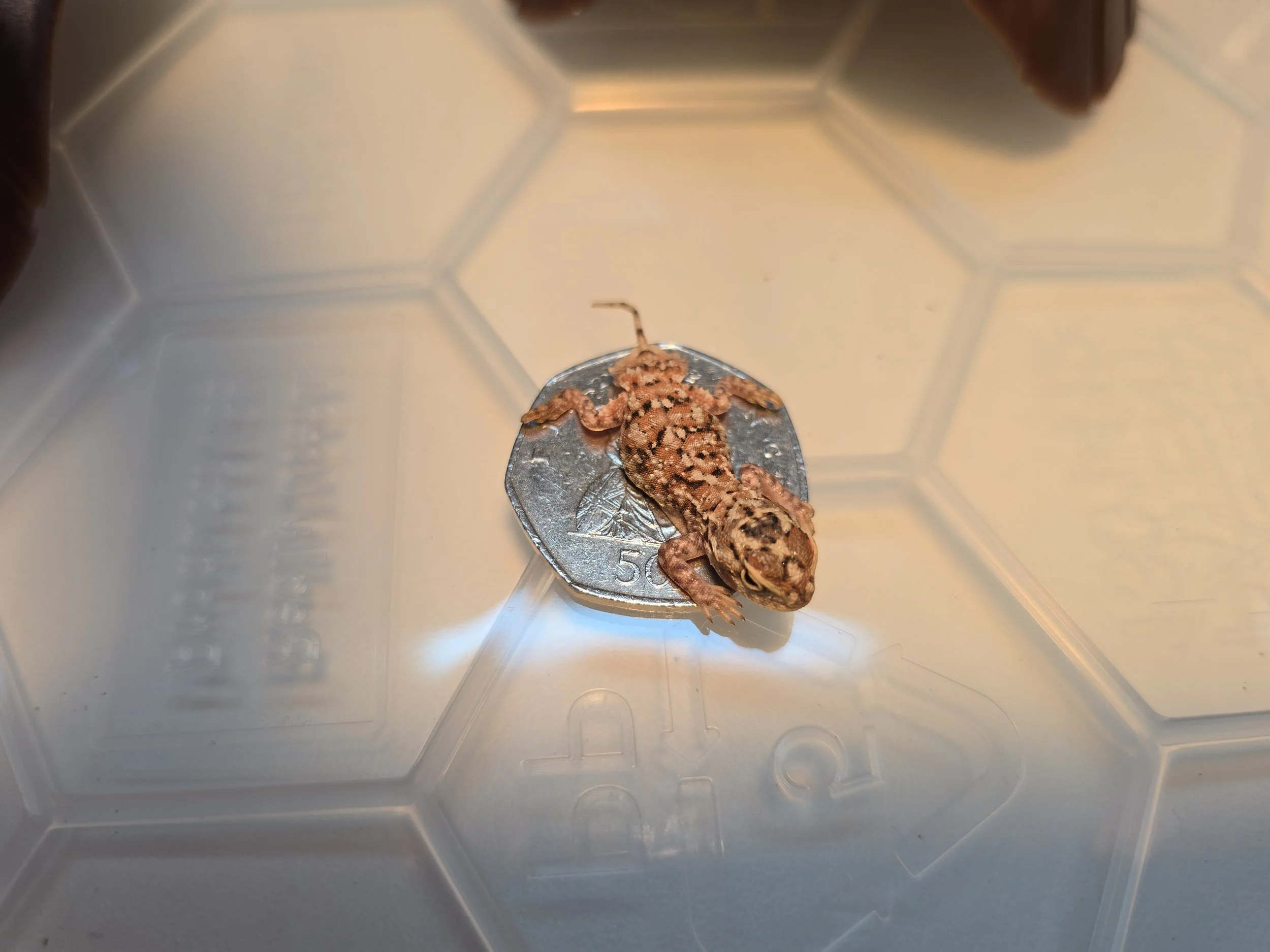
Xenagama Taylori - Shield Tailed Agama
IF something happened and I was suddenly forced in to a position where I could only own one type of lizard ever again in my life. Without question I’d choose Xenagama Taylori - Shield Tailed Agamas.
Shield tailed agamas are small, diurnal and terrestrial agamids that come from the horn of Africa (think Somalia region). They live on sandy, scrubby landscapes and range across flat plateaus to hillier land. Their climate sees extremes from heat and low humidity to a wet season with flooding and high humidity. In the wild they live in burrows but enjoy actively basking and climbing low level rockery, shrubbery and other features.
Shield tailed agamas are robust little critters. Adults reach a maximum length of 10cm including tail and are about 40-50% wide as they are long. Babies are typically the size of a finger nail when born but they are like cute little cartoon villains. Absolutely insatiable and would literally eat until they explode.
The most distinctive feature of shield tailed agamas are their tail. The tail features a large ‘shield’ base with numerous, hard spiney protrusions and a short traditional looking tail on the end. The function of this tail is to form a door or barrier to predators attempting to enter their burrows. Think of them as being the lizard version of a wombat.
Fun fact regarding the tail, in adults this traditional looking small, thin tail can reach 2cm in length but typically the breeder, when that animal was a baby, keep the babies together too long and it was nibbled down to a stump by the other siblings. It’s actually used by the males during courtship and they give this a little wiggle to the females to show off.
Housing
Housing wise I provide a terrestrial vivarium with a minimum length of 3ft or 90cm. Despite being small and dumpy, they’re fast and run about often. That length is the absolute minimum for one animal or pair. Height isn’t particularly important but they do love to climb, despite being a little clumsy. I provide climbing opportunities with short falls.
Substrate depth is important. Provide at least four inches of substrate. This often means customising the vivarium with either a pond liner in the bottom or separate plastic enclosure inside the base of the tank. Otherwise you will find the substrate flooding over the door rails constantly if using a front opening set up. I use a blend of around 50% desert substrate, 30% soil and 20% cococoir. This combination holds tunnels really well and is easy for them to dig into.
Another consideration for their enclosure is the humidity aspect. If you’re considering breeding them you will need the bottom properly lined or a UPVC viv. Otherwise you will find the wood warping when you dump litre upon litre of water into the enclosure to replicate the rainy season.
Quick cohab guide - Males and Males is a big no no. Females can cohab but check for bullying with dominant female chasing and biting the other. Separate immediately if this happens. Males can cohab with one or several females but I’ve often found this leads to conflicts within the females around breeding time. All of my agamas are kept in pairs with the exception of one female who seems to be disliked by every other agama I have (poor Sasha).
Temperatures
As one would imagine, you need to replicate desert conditions. A basking spot of around 30-40c and background temps of 25-28c. Remember they should have the opportunity to create self made burrows and these in turn assist with the thermoregulation with the cuties disappearing into the tunnels for some respite from the heat. Aim for around 12 hours of light each day.
Evening temps - aim for low 20c’s which will likely mean using a ceramic bulb (CHE) or similar. 21-24c is ideal.
Lighting
Shield-tails require UVB with a high UVI. Depending on distance within your enclosure this may mean 10-12% T5 bulbs. Aim for 3-6 UVI
Light = being awake and darkness = sleep. Literally with these guys. I’ve found them mid way through drinking and fallen asleep when the light went off. It’s a really funny part of their character. Mostly once the light goes off they will retreat into burrows but like I just mentioned, sometimes they will just fall asleep where they were.
Food and drink
Shield-tails are meant to be omnivores. By meant to be I know they are, but the practical day to day owning of these guys has lead me to believe they’d only consider the vegetarian option if the insectivore diet is not available. I have tried full leaves, ripped leaves, mulched up veg, I’ve also tried planted enclosures with edible plants and absolutely no takers whatsoever. And I currently have a dozen animals, had several dozen at various times. Not one has shown interest in plant matter and from discussing this with other owners, it would appear I am not alone with the odd unicorn agama eating some green!
Day to day feeding is crickets, mealworms, calciworms, locusts, dubia cockroaches and morio worms. I cannot stress enough the need to restrict the diet of these guys. They are terrible for clearing their plate so feed the maximum you would like them to eat rather than extra and accounting for escapees. Feeding schedule wise I feed :
0-3 months - Daily, missing one day a week
3-6 months - 4-5 times weekly
6 months plus - Every second day. For example Monday, Wednesday, Friday, etc.
Provide a bowl of fresh drinking water with easy access in and out. Obviously don’t make it deep enough for them to drown in! Shield-tails will take water when sprayed and essentially hang their tongues out and bite water to catch it or if drinking from the bowl, they will bite the water, capturing it in their bottom jaw and tilting the head back to swallow. For babies stick to misting. They are too small for many suitable water bowls and will lick water from the walls of their enclosure or drips from features/fixtures.
If you provide a large wading bowl firstly be prepared for this to be filled with substrate before your hand even leaves the enclosure. Secondly they will sometimes just plonk themselves down in the water and lie in it. The first shield-tail I had I honestly thought he was dead. Came back and found him star-fished in the bowl. I scooped him out and he was NOT happy with me. Back in he went and laid back down an hour or so later.
Handling
It’s important to be aware these guys are fast. Comically fast vs how they actually look. You’d think they were lumbering little potatoes but no, they can almost teleport from one end of their enclosure to the other. They’re also extremely athletic for their size. If a calciworm escapes and manages to change into a solider fly, it’s entertaining to watch them leaping into the air to catch them and they always catch them after a few attempts.
With the above in mind, keep a good hold of them and they will sit happily within your thumb and fingers. I genuinely would not recommend allowing them to freely walk around your hand or arm, because they will run, they will not consider the height they’re at and they will fall. The males may threaten you sometimes with an open mouth and they may bite, but it’s not even enough to break the skin never mind requiring any form of medical attention.
Males vs Females
Males are significantly more confident than females. Often after a period of time of inactivity, if I walk passed their enclosure the female may bolt down their burrow. The males usually stay still and just keep a measured eye on you. If you have a confident female expect this to extend to being able to move things around in their enclosure without them bolting rather than being easy to capture. The males range from ‘confident female’ to absolutely unbothered by you. Several of my males can be picked up without a chase and will happily sit in the hand. They’re even handled by my kids (under supervision) without issues. Just for real world context - I can hand feed all the males, I cannot hand feed a single female.
In terms of sexing, the males will likely make their sex clear upon entering puberty. With a stunning bright blue colour appearing under their chin extending from below their mouth to the chest and onto the tops of their arms. They will run about. Head bob. Chase the females. Wiggle their little thin tail endings.
IF the males are not displaying, they can be sexed by holding and checking their cloaca area. The males will have a waxy orangey area near their femoral pores. I joke this is to protect their bits from the female’s spikey tail but it may actually be the case.
Females have a higher calcium demand than males and may suffer from deficiencies. Ensure you provide a suitable calcium, D3 and multi vitamin schedule.
Other info
These guys are hilarious and I can watch them for hours. The males especially around breeding time or peak heat/summer conditions, will run about endlessly and get up to every bit of mischief they can. With that said they can be very boisterous with the females and I have had one female with an injured eye from a rhino charge from her hubby (Barack and Michelle).
I tend to spray their enclosure 3-4x weekly and aim for a regular humidity of 30-60% out with breeding season.
Sexing is possible from six months.
Shield tails tend to suffer being unable to completely clear shed from their spikey tails and the tip of their thin tail. I bought a picking set with micro tweezers and it’s a very therapeutic session picking off old shed from them. It also increased their exposure to you and being handle. BUT KEEP A GOOD HOLD.
Common health complaints are eye and ear infections from sand/grit. This happens very rarely but it is worth noting.