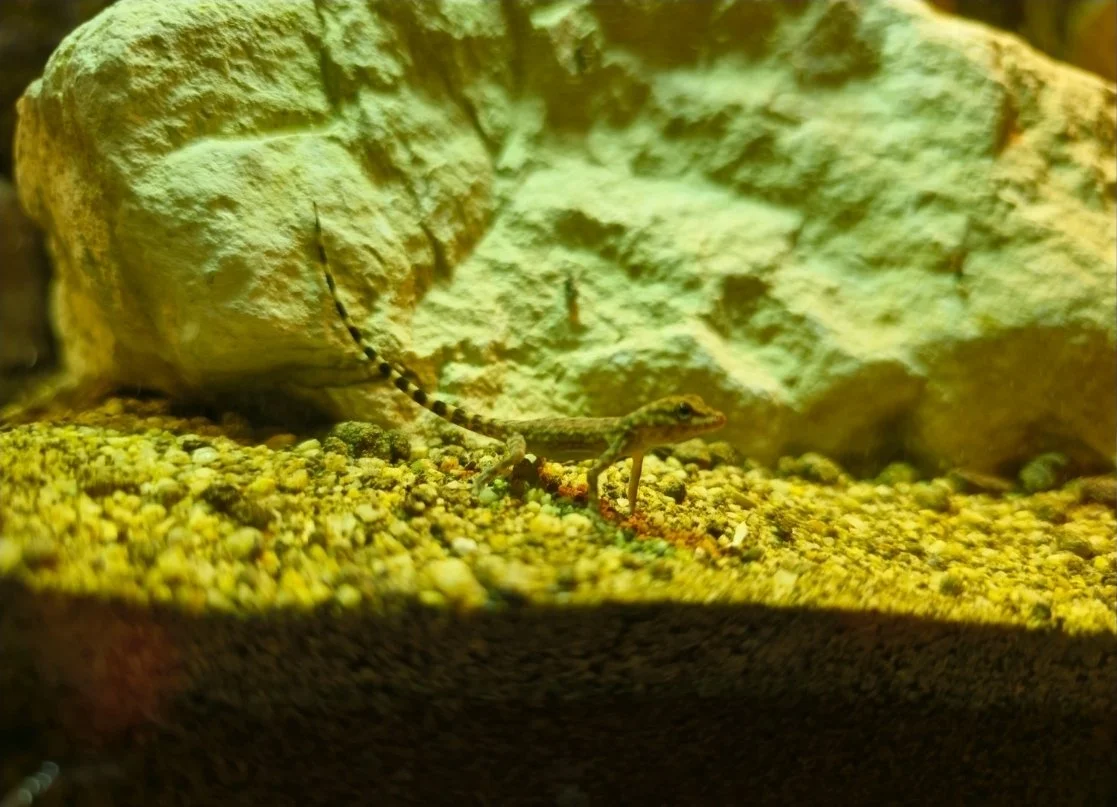
Pristurus Celerrimus
Pristurus Celerrimus
Pristurus Celerrimus are one of the larger Pristurus species but are a sleak build rather than the Carteri stocky build. They are a diurnal, arboreal species and very territorial. Celerrimus comes from the latin word meaning the fastest - and they are very fast! For that reason I would not recommend handling them unless you are willing to set aside an entire day chasing them down.
Celerrimus typically have a snout to vent length of 40mm (4cm) and a tail length up to 80mm (8cm). Their bodies are a matte browny-green colour with lighter coloured spots for camouflage and their tails are banded with black and light tan to yellow colours alternating along it’s length. If the tail is not striped along it’s length and instead is dark from one point to the tip, it’s almost certainly a regenerated tail. And almost certainly it’s been nipped off by another Celerrimus! The striped tail also gives them their colloquial name of the ‘bar tailed gecko’.
Celerrimus are another semaphore gecko and are also called Oman Rock Geckos. Both give a clue to their behaviour. Semaphoring is a fancy term to describe animals that wave limbs or tails to communicate with each other. If you have more than one in an enclosure, you’ll see these behaviours constantly throughout the day and it’s absolutely fascinating to watch! And Oman Rock Gecko informs they are found in Oman and live on rocks…
Housing
Think vertical with these guys. Whether you’re housing a single animal or pair, aim for a 45cm tall and 30×30cm enclosure at minimum. Ideally 60cm tail. Provide lots of climbing opportunities. Do not house two males together or groups. They are very territorial and will constantly be in conflict resulting poor welfare conditions.
Substrate
A desert mix or sand base with top soil is suitable for adults. I recommend a desert mix 2/3 and 1/3 soil. Aim for around 2-3 inches across the enclosure or if breeding, 2 inches across most of the enclosure with a spot around 4 inches deep to encourage laying in that spot (if breeding)
Climbing Opportunities
Celerrimus spend most of their lives climbing. Very rarely do you see them on the ground unless chasing a prey item, moving between spots or laying eggs.
Rocks are great for climbing and basking. I have rocks under each basking lamp and see them basking multiple times per day. Not only do they provide a platform to bask and climb on but they offer places to hide and retain and radiate heat.
Branches provide perfect climbing opportunities both on top of and underneath each branch and can be used for shelter.
Backgrounds are used extensively by Celerrimus and I would highly recommend them. Their claws are relatively small and grip well allowing them to run up and down vertical surfaces with even light traction. I use CT1 as safe sticky compound to paint the enclosure’s walls and slap on some of the sandy substrate. Your Celerrimus now has a 4D playing area!
Hides are not something I have ever seen Celerrimus use. Mainly because they are so flighty and shy, I assume they don’t want to be cornered.
Other Decorations
If you have the opportunity to provide any other climbing structures – great!
Lighting
UVB is essential for their health and wellbeing. Use a suitable high strength UVB light form and aim for a UVI around 5-6 – essentially Ferguson Zone 4. In the wild these guys are basking in desert sun but ensure there is ample opportunity to escape from the blaze.
Heating
Aim for a basking spot around 35-40c, 95-104f (in freedom units). With a background temperature of 30c. You can achieve this easily enough with a single 25-50w basking bulb depending on enclosure size and the excess heat will escape through the mesh.
For evening heat I use a either a heat mat under the terrarium set to 20c which not only helps with temperature but can also aid incubation for any hidden, fertile eggs. Or a ceramic heat emitter which will offer the same temperature regulation.
Throughout most of the year I have light and basking heat set for 06:00-18:00 on a digital timer. Then 18:00-06:00 for evening. Around November time I reduce ‘day’ to 10 hours then in December 8 hours. Increase again in January then back to normal again in February. I also drop the temperatures to accompany each hour change
November - 06:00-16:00 and background temperature 28c
December - 08:00-16:00 and background temperatures 25c
January - 06:00-16:00 and background temperature 28c
February to October - 06:00-18:00 and background temperatures 30c
Remember to regulate temperatures using a suitable thermostat. Reptiles love some heat but don’t tolerate being cooked.
Watering
Misting is the best way to water your Celerrimus. Simply get a small spray bottle and 5-8 sprays on them and around their enclosure is sufficient. They will lick the water from their mouths/eyes/head and drink from the enclosure sides.
Get a spray bottle from a cheap hardware store, in the UK Poundstretchers sell them for 69p vs about £5 for a reptile branded one.
As an aside, every third watering I add about 20ml of Zolcal (liquid calcium supplement) to every 500ml bottle. Just for extra calcium. Really they’re only drinking a small amount of water anyway and this tiny addition is just extra help for their little bodies. This isn’t really a requirement but I’ve found it helps. If you have an egg laying female do this every time or every second spray.
Misting programme suggesting:
Up to 1 month old – mist daily
1 Month old + – Misting once daily, occasionally skipping a day to replicate natural cycles.
Feeding
Like all Pristurus members, Celerrimus are insectivores. A good rule of thumb for any lizard is no food source wider than the space between the eyes. This is considered the thickest meal they can swallow safely. Dusting a calcium supplement each feed is recommended and add a multi vit supplement powder every 3rd feed.
0-1 Month – Small crickets, fruit flies, mini mealworms. Feed daily. Filter out your meal worms by grabbing a handful and sorting for the smallest ones possible
1-2 months – Small crickets, small calci worms, small meal worms. Feed five to six days a week.
2 months plus – Much the same as the above, except larger meal worms can now be accommodated. Crickets and calci worms can be scaled up to appropriate sizes. Feed every second day throughout this age into adulthood. For example Monday, Wednesday, Friday, Sunday, Tuesday, etc
It should be noted that as adults, a sudden increase in feeding quantity and frequency can stimulate a breeding response.